

On 12 November 2026, Tokyo hosted the International Matcha Congress (IMC) – according to its organisers, the first international conference devoted entirely to matcha. Tea growers, Japanese producers and trading houses, café chains from New York, London and Seoul, researchers and the people who built quality standards for specialty coffee spent a full day around one question: how do we describe and assess good matcha in a language the whole world shares?
We were not in Tokyo ourselves. But we followed the programme closely, because the congress dealt with exactly the questions our customers ask us every week: where does this matcha come from, what does its grade really mean, and why do two teas with the same name differ so much in colour, taste and price?
Why now: a boom that has outgrown its rules
The organisers put the global matcha market at about USD 5.1 billion in 2025, and Japan’s green tea exports grew from 20.4 to around 72 billion yen between 2021 and 2025. Matcha latte has become an everyday drink: one New York café chain says matcha now makes up more than half of its sales.
The growth, however, has run ahead of the industry’s foundations. The congress named the problems openly:
- no shared international definition of what may be sold as matcha,
- no grading system, so quality is not reliably reflected in price,
- more mislabelling and misleading claims, because there is no standard to check against,
- fewer growers and tight supply – converting a field to shaded tencha takes years.
The congress at a glance
- When and where: 12 November 2026, Yaesu, Tokyo – one day, five panels, an exhibition of matcha brands and open cupping sessions.
- Organiser: the International Matcha Association (IMA), a non-profit founded in Tokyo in April 2026.
- On stage: Japanese producers and trading houses, café and brand leaders from the USA, UK and South Korea, the Specialty Coffee Association, tea associations of the USA and Canada, and academics.
- Support: Japanese ministries, tea-growing prefectures and tea industry associations.
- Next edition: IMA plans to hold the congress every year.
The big idea: learn from specialty coffee
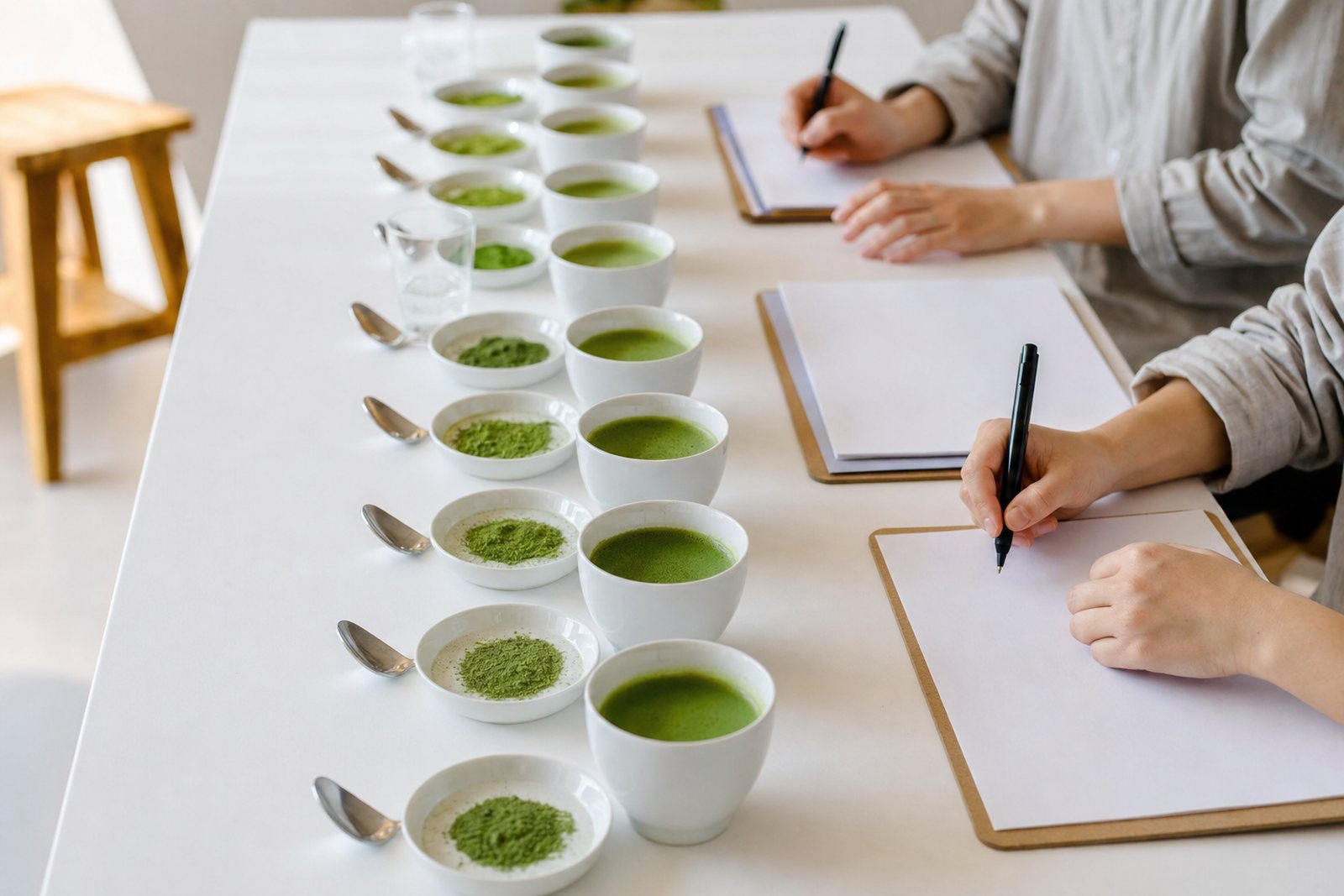
The key session of the day asked what “good matcha” actually is. Specialty coffee faced the same question decades ago and answered it with shared cupping protocols, trained graders and, more recently, a structured value assessment. Only once quality could be measured and described did the market start to pay for it – and that money found its way back to the farms.
IMA wants to walk the same road for matcha: a common vocabulary, a framework that looks at flavour, aroma and texture as well as traceability, transparency and sustainability, training for professional evaluators, an award and regular cupping forums where the criteria are tested in practice. Speakers also stressed that a lot of matcha quality is measurable – cultivar, shading, harvest time, processing and storage all leave traces in the composition of the tea.
How IMA describes matcha today
In June 2026, IMA published a working description of matcha: leaves of the tea plant Camellia sinensis, grown under shade, steamed and dried without rolling (tencha) and ground into a fine powder. IMA stresses that this is a starting point for dialogue, not a standard – and that powdered teas made for industrial use deserve clearer labelling of their own.
One thing is not part of the description: origin. Here national rules can go further. In the Czech Republic, for example, Decree No. 187/2023 Coll. ties the name “matcha” to tea from Japan. We believe that origin belongs in any honest description of quality – at the very least it has to be declared and verifiable, batch by batch.
What it means for cafés, brands and buyers
- Ask for origin and a lab report of the batch you buy. These are the first things any future standard will check.
- Expect grade names to change. Today, words like “ceremonial” or “culinary” mean whatever each seller decides. A shared grading system would make offers comparable.
- Expect prices to follow quality more closely. That is the whole point of grading – and it rewards growers who invest in better tea.
- Plan ahead. The congress confirmed that supply of good Japanese tencha remains tight.
Where Kyosun stands
Everything the congress is trying to build is close to how we already work. We buy matcha exclusively from Japan. We have been testing our grades in an accredited laboratory since 2014, and the reports are public at quality.kyosun.com. This autumn we also had 23 matcha teas from the market tested side by side – the results are in our article 23 Matcha Teas, One Laboratory.

That is why we welcome the effort to give matcha a shared language for quality. We will follow IMA’s work closely and keep you informed about what it means for your orders. If you want to compare our grades in your own cup, our 50 g samples are the easiest way to start. Questions about origin, grades or lab reports: sales@kyosun.com.
Your Kyosun Tea(m)
Sources: matcha-congress.com (programme and press releases of IMC 2026), matcha-association.org (IMA statement of 8 June 2026 on labelling and classification of matcha). Market size: Grand View Research, “Matcha Market” (2025), and export figures: Trade Statistics of Japan, Ministry of Finance – both as cited by the organisers. Kyosun did not take part in the congress and is not a member of IMA. Images are illustrations, not photos from the event.