Same word on the label — very different powder in the pack. In September 2026 we bought 21 matcha brands on the Czech market as ordinary customers and sent them, together with two of our own teas, to an accredited laboratory. Same laboratory, same methods, same tests for every sample. Across the 21 market brands we found a 32-fold difference in price per gram, a 14-fold difference in lead and a 25-fold difference in chromium.
The test in five points
- 5 of 21 products declare China or South Korea — or contradict themselves about origin. All five are sold as matcha.
- Two teas with the organic logo contained two insecticides at 61 to 130 times the level the laboratory applies to organic products.
- Lead differed 14-fold, chromium 25-fold. The highest lead was in two products declaring China.
- With the highest-aluminium sample, 2 g of matcha a day gives almost half of the EFSA tolerable weekly intake — from matcha alone.
- Colour, measured in a minute, predicted the laboratory results surprisingly well.
Watch the video
The whole test in under 14 minutes, with animated charts. Watch on YouTube →
Full disclosure first
We are Kyosun, an importer of Japanese matcha based in the Czech Republic. So let us be clear from the start: we commissioned this test, we paid for it, and we included two of our own teas — Kyosun A+++ and Kyosun A+. They were bought, sent and measured exactly like every other sample, in the same laboratory orders and with the same methods. In the charts they are hatched, so you can always set them aside and look at the market on its own.
The other 21 brands stay anonymous and are numbered Sample 1 to 21 by their overall result. This is not about naming anyone. It is about what the market really looks like — and what to look for when you buy matcha for your café, your production or your shelves.
Why it matters
First, the name. Czech food law (Decree No. 187/2023 Coll., Section 4(3)) says that only green tea made by grinding the dried youngest leaves of true tea from Japan into a fine powder may be labelled matcha.
Second, supply. In 2025 Japan produced about 6,300 tonnes of tencha, the leaf that matcha is ground from. Chinese state media report more than 12,000 tonnes of matcha a year from China alone — roughly 70 % of world production. Demand has outgrown Japan, and not everything sold as matcha comes from there.
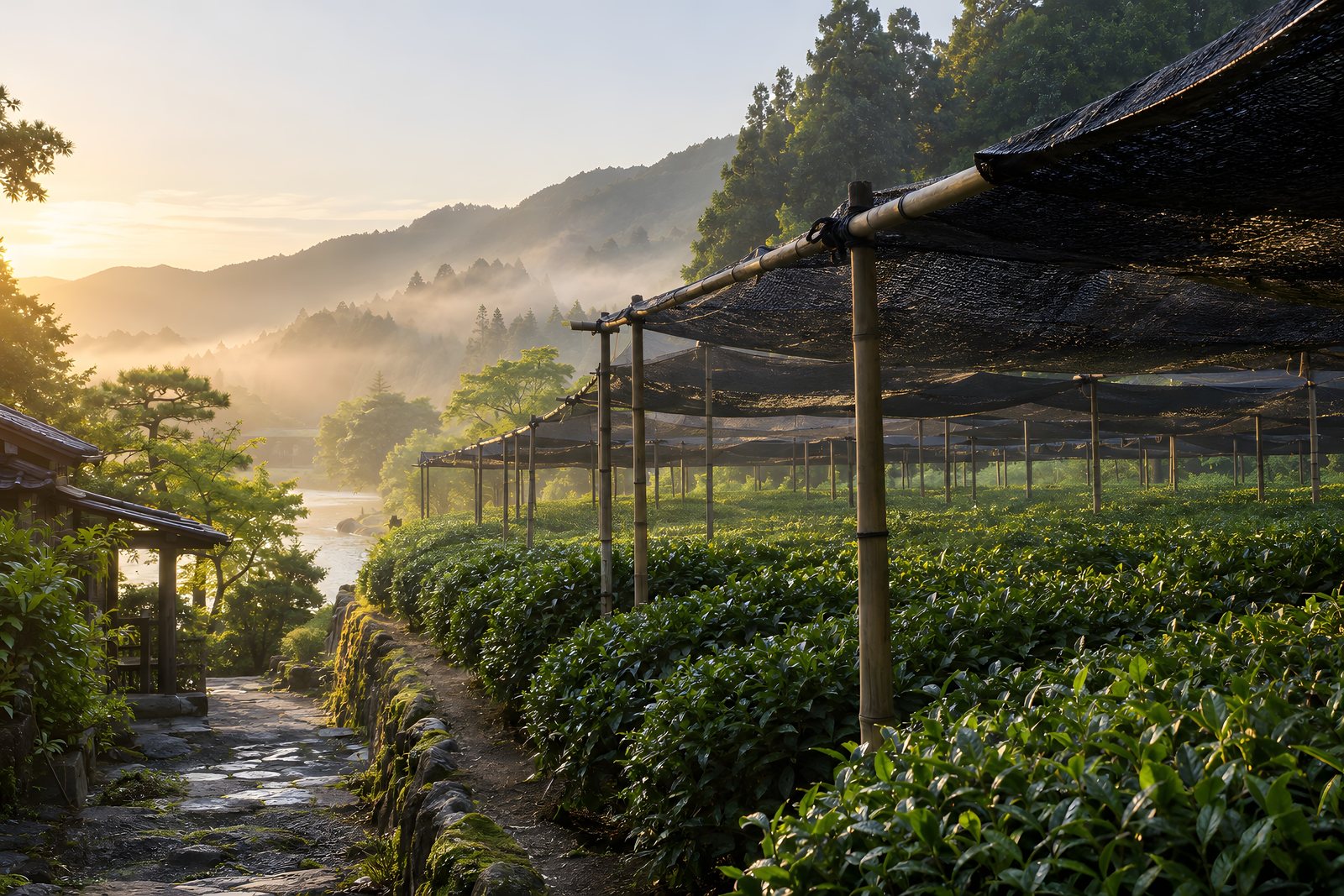
Third, and most important: matcha is not brewed tea. With leaf tea you drink an infusion and throw the leaves away. With matcha you whisk the whole leaf into water and swallow all of it. Whatever is in the leaf — good or bad — ends up in the cup, and in your customer.
How we tested
In September 2026 we bought 21 matcha brands on the Czech market as ordinary customers — from large online stores, pharmacies and specialist shops; from the cheapest powder to premium brands, organic and conventional, mostly in pouches, some in tins. The laboratory needed 300 g per sample, so for small packs we bought several packs of the same product, always from one batch. Each sample is therefore one batch.
Before shipping we photographed every pack and saved the seller's web page. The samples then went to ALS Czech Republic, an accredited laboratory; pesticides were screened by ALS Laboratories in the United Kingdom.
- Measured: lead, cadmium, chromium and aluminium; total microorganisms, E. coli and salmonella; caffeine; a screen of pesticide residues. Colour (a*) we measured ourselves with a colorimeter.
- Not measured: arsenic, mercury, moulds, mycotoxins, perchlorate, catechins — so nothing here says anything about those.
- Cost: about € 1,600 on samples and about € 6,350 on the laboratory.

Origin: the strongest signal
Five of the 21 products declare China or South Korea instead of Japan — or contradict themselves: Japan on the pack, China on the seller's website. All five are sold as matcha.
The median lead content of the 16 products of declared Japanese origin was 0.093 mg/kg; for the other five it was 0.617 mg/kg — more than six times higher. Chromium was twice as high and aluminium almost half as much again. Four of the five fell into our lowest colour grade; of the 16 Japanese ones, three did. And all five were among the eight cheapest products in the test.
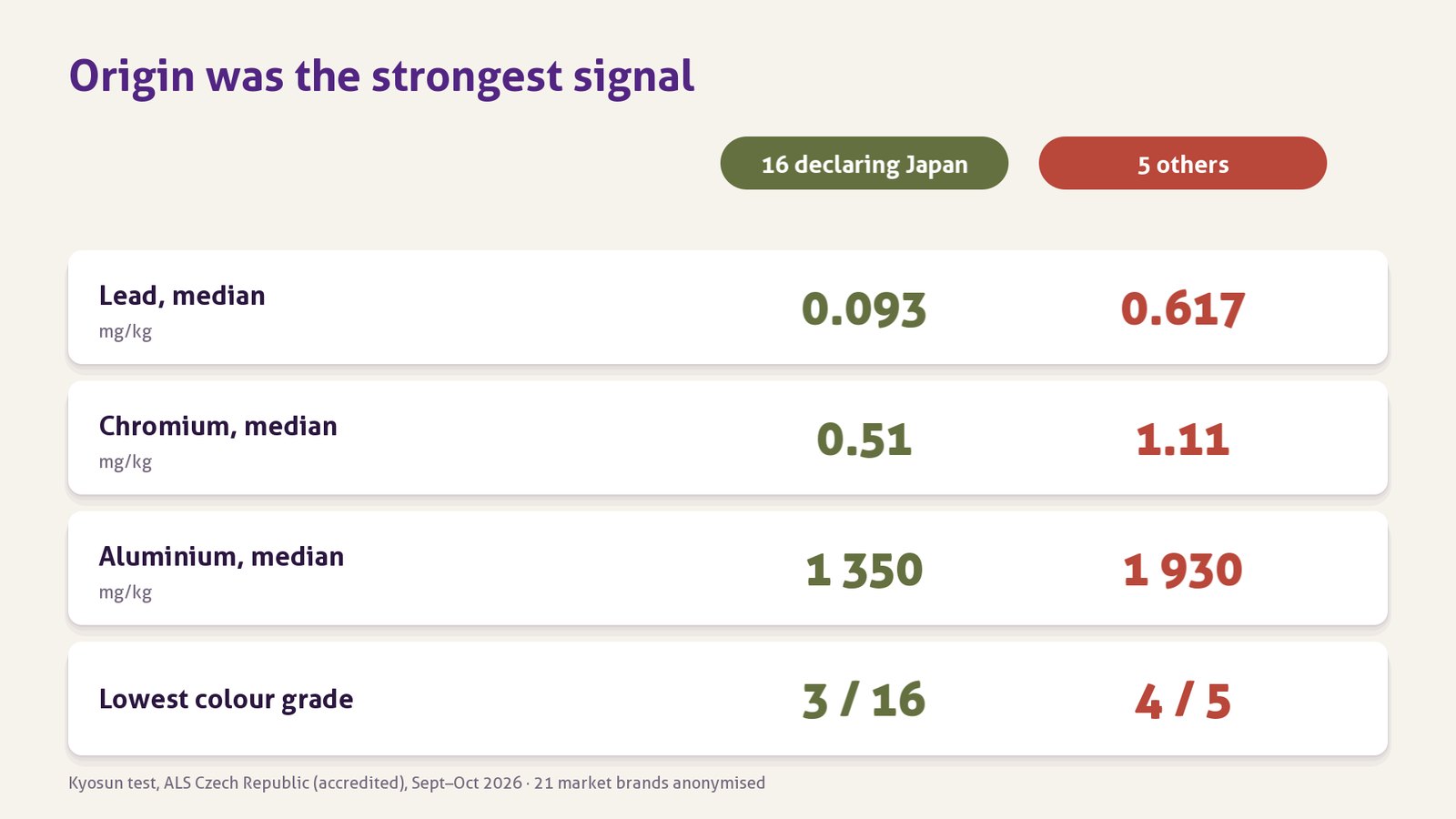
These are small groups, so this is an observation, not statistical proof. But the difference holds across every indicator we looked at.
Pesticides: an organic logo is not proof
Here the news is mostly good: 19 of the 23 samples had no detectable residue at all. But three of the four that did are tied to organic claims.
Two products carry the organic logo on the pack. Organic farming does not allow synthetic pesticides like these, so the laboratory assessed both against the level it applies to organic products. Both contained the same two insecticides, bifenthrin and chlorfenapyr: Sample 18 at 68 and 130 times that level, Sample 15 at 61 and 130 times. Even with the laboratory's measurement uncertainty of 50 % taken in their favour, they remain at least 30 times above it.
The third product has no organic certification on the pack, but its website describes the tea as grown on small organic tea fields. The laboratory found seven different residues; one of them, chlorpyrifos, was 2.5 times above the EU maximum residue limit for tea. Chlorpyrifos has not been approved in the EU since 2020. The fourth product, with no organic claim, had two residues, both far below the limits for tea.
We are not a regulator and we make no legal judgments. The pattern is clear all the same: an organic logo on its own is not proof. A lab report is.
Heavy metals and aluminium
A tea plant takes up metals from the soil it grows in — and from polluted air and water. With brewed tea only part of them reaches the cup; with matcha you swallow the whole leaf. EU law sets no limit for lead, cadmium, chromium or aluminium in tea, so we compare the samples with each other, and for lead we use our own benchmark of 0.1 mg/kg — not a legal limit, just a line for orientation.
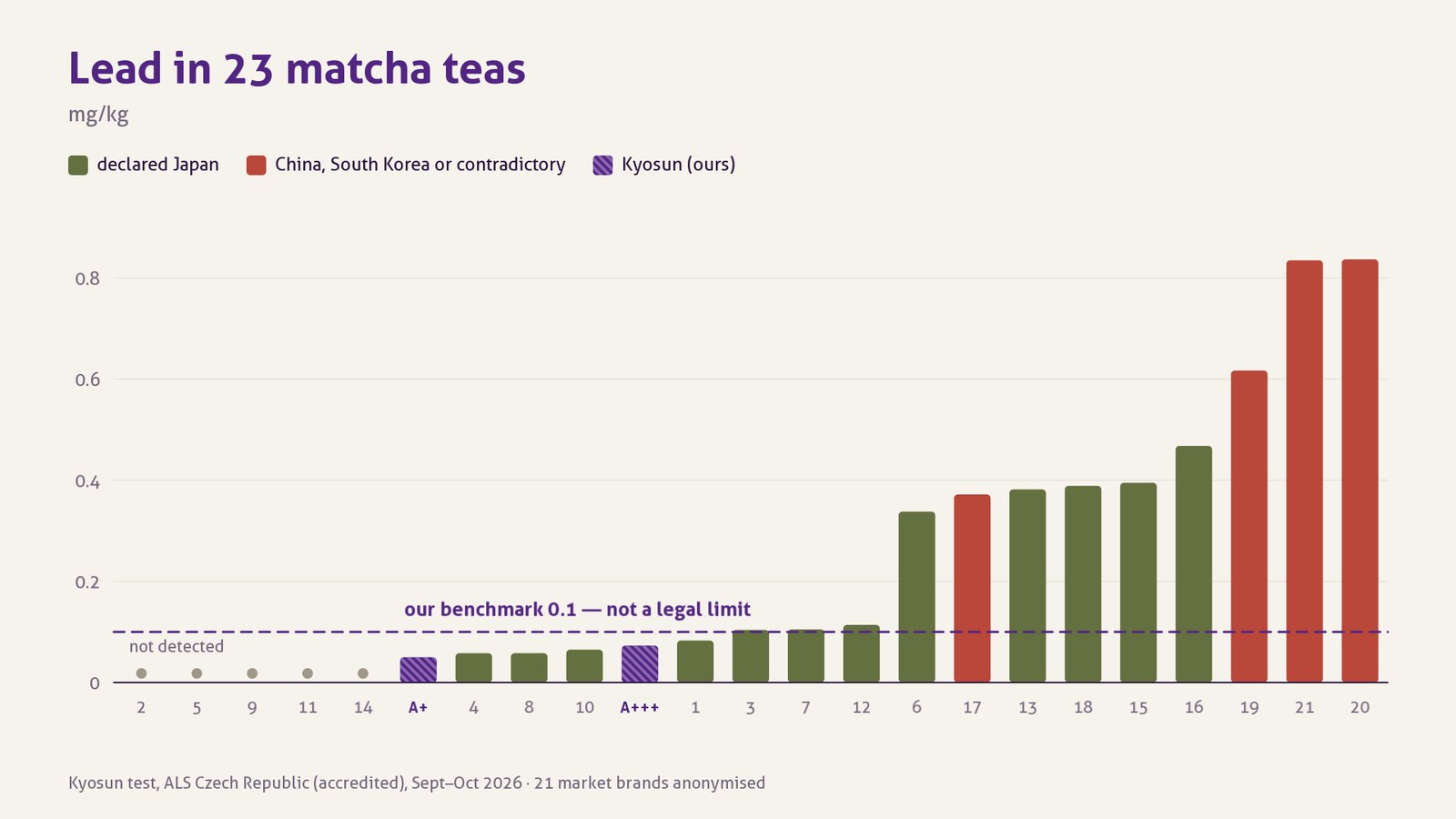
Lead matters most: it builds up in the body and, according to EFSA, there is no known safe level of intake. 12 of the 21 market brands were above our benchmark. The highest values, 0.84 mg/kg — more than eight times the benchmark — were in two products whose packs or websites declare China. In five samples the laboratory found no lead above its detection limit.
Cadmium also builds up in the body, mainly in the kidneys. Here the picture is better: 16 samples were below the limit of quantification, and the highest value was again in a product declaring China. Chromium ranged from 0.10 to 2.45 mg/kg, a 25-fold difference.
Aluminium is a special case. The tea plant accumulates it naturally, so every matcha contains a lot — but the range was still 4.5-fold, from 550 to 2,450 mg/kg. An adult of 70 kg who drinks 2 g of matcha a day (one teaspoon, as most packs suggest) gets, over a week, 11 % of the tolerable weekly intake set by EFSA with the lowest sample, 28 % with the median sample and 49 % with the highest. That is from matcha alone: according to EFSA, an adult's normal diet already supplies roughly 20 to 150 % of that intake. With the highest sample, anyone whose diet provides more than half of it would go over the limit. This is not a risk assessment, just arithmetic — but it shows why, with matcha, what is in the powder matters.
Colour and “ceremonial”
The greener the powder, the younger and better-shaded the leaf. We measured colour on the a* scale and sorted the samples into our own grades, set before any laboratory results arrived. Seven of the 21 market brands landed in our lowest grade, which we call unacceptable quality. None of the market brands reached the top grade; Kyosun A+++ did.
Eleven products present themselves as ceremonial or premium. Four of them did not reach ceremonial colour, and two of those fell into the lowest grade. “Ceremonial” is a marketing word; no law defines it.
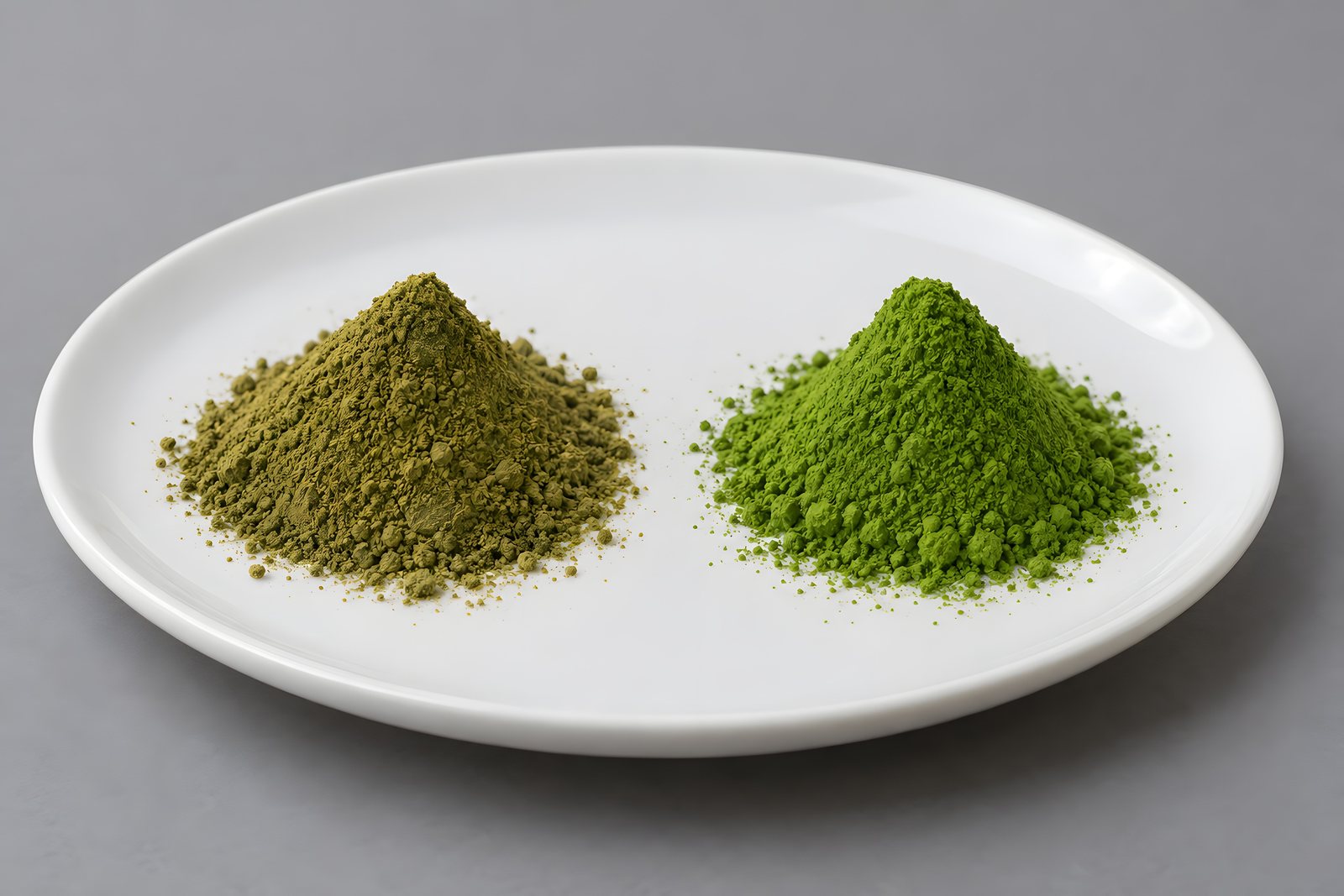
What surprised us: colour, which takes a minute to measure, predicted the laboratory results well. The seven greenest market samples had a median lead of 0.104 mg/kg, the seven palest 0.382 mg/kg. The greener ones also had more caffeine and less aluminium. None of the greenest declared a non-Japanese origin; four of the palest did.
Does price help?
Yes, but not reliably. The average result improves with price, yet within each price band the results vary a lot. One affordable Japanese matcha, at about € 20 per 100 g, finished fourth overall; some more expensive ones carried pesticide residues. For full transparency: Kyosun A+++ was the most expensive tea in the whole test, and Kyosun A+ cost about a third of that.
Price alone is no guarantee. But the very cheapest end of the market is where the non-Japanese origins, the pale colours and the highest metals were concentrated.
Overall ranking — with our weights
Finally we combined everything into one overall ranking. The weights are ours and we show them openly: origin and pesticides count most, then metals, microbiology and colour, then caffeine, and price least. Kyosun A+++ came first and Kyosun A+ third, with a market brand, Sample 1, between them. Because the weights are our choice, we have shown the key results separately above. At the other end, all five products with a non-Japanese origin, or a contradiction about it, finished in the bottom half.
What this test cannot tell you
- Each brand was tested once — one batch, bought in September 2026. It shows what we bought, not a brand's entire production.
- We did not test for everything: arsenic, mercury and mycotoxins, for example, were not measured.
- Colour was measured by us, and the colour grades, the lead benchmark and the ranking weights are our choice.
- This is not an official inspection. It is one importer's honest look at the market.
What to ask your supplier
If you buy matcha for a café, a production line or a shop, these are the questions the results point to:
- Japanese origin, stated clearly — and the same on the pack, on the website and in the specification.
- Don't rely on “ceremonial” or “premium”. Look at the colour, and ask for a sample.
- Don't treat an organic logo as proof. Ask for lab reports on metals, pesticides and microbiology.
- Check the reports. They should come from an accredited laboratory and name the batch they describe. One report, one batch. If a supplier shows the same report for years, either they have sold one batch all that time — or the report is being used for batches it never tested.
Ours are public: every laboratory test of our grades since 2014 is at quality.kyosun.com. If you want to see the difference for yourself, 50 g samples of our grades can be bought directly in the Samples category. For wholesale offers, write to sales@kyosun.com.
Laboratory: ALS Czech Republic, s.r.o. (accredited); pesticide screen ALS Laboratories (UK) Ltd. Samples bought in September 2026, results October 2026. Colour (a*) measured by Kyosun with a colorimeter (not accredited). One sample per brand, each from one batch. Prices converted at 24 CZK = 1 EUR. Aluminium exposure: EFSA Journal 2008 (754). This is not an official inspection.