
Matcha is an exceptionally delicate product. The very quality that sets it apart from regular green tea – the whole leaf ground into an ultra-fine powder – also makes it more sensitive to storage conditions. Temperature, light, air and moisture gradually affect its colour, aroma, flavour and the content of naturally occurring compounds. Proper storage is therefore not just a matter of the best-before date, but above all of keeping matcha as close as possible to the qualities it had straight after production.
Why Matcha Is More Sensitive Than Loose-Leaf Tea
Grinding the leaf dramatically increases the surface area that comes into contact with air and the surrounding environment. At the same time, matcha contains chlorophyll, catechins and other polyphenolic compounds, amino acids and aromatic substances – precisely the components responsible for its vivid green colour, fresh aroma and characteristic umami. The poorer the storage conditions, the faster these qualities fade.
What Research Revealed About the Effect of Temperature
A study published in the journal Food Science and Biotechnology monitored matcha stored for two months at different temperatures. The trend was unmistakable: the higher the temperature and the longer the storage, the more pronounced the changes. Colour was the first to shift – the matcha lost its brightness and intense green hue. At the same time, the content of phenolic compounds, flavonoids and catechins including EC, EGC, ECG and EGCG declined, along with antioxidant activity measured by the ABTS and DPPH laboratory methods.
These laboratory tests say nothing about effects on the human body – they are used to compare chemical changes in the product. The takeaway, however, is practical: matcha stored under unsuitable conditions is, over time, no longer chemically the same product as when it was freshly packed.
Four Factors to Keep in Check
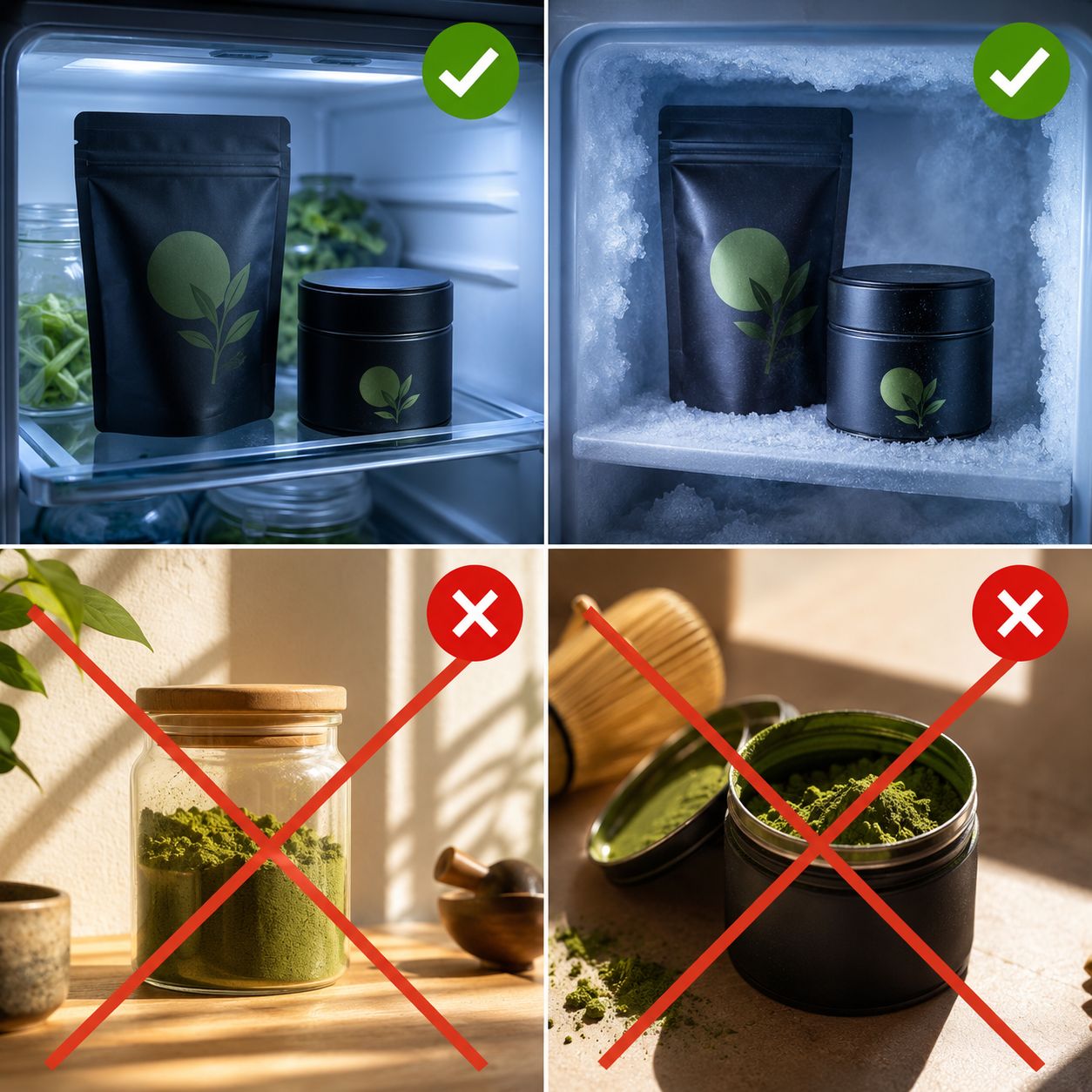
- Heat – speeds up chemical reactions. Don't store matcha next to a coffee machine, stove or oven, or in places with fluctuating temperatures.
- Light – natural pigments react to it by losing their colour. An opaque container is a better choice than a decorative glass jar on a shelf.
- Air – oxidation gradually alters the aroma, flavour and colour. Seal the packaging carefully after every use.
- Moisture – the fine powder absorbs it easily, forms clumps, and chemical changes accelerate. The packaging must be genuinely airtight.
Does Matcha Belong in the Fridge or Freezer?
Yes – cold slows the changes down. But one rule applies: never open a cold package immediately after taking it out. In a warm environment, moisture from the air would condense on the powder – exactly what we're trying to avoid. Let the sealed package come to room temperature first. The freezer is suitable for long-term storage of unopened, well-sealed packages, not for a container you use every day. And since matcha readily absorbs odours, don't store it in a poorly sealed container next to onions, cheese or other aromatic foods.
Recommendations for Cafés and Food-Service Operations
- Don't open a multi-kilogram package several times a day – set aside a smaller working portion and keep the main supply sealed.
- Divide larger stock into separately sealed packages and open them one at a time.
- Watch the colour: a shift towards dull, olive or yellowish tones is the quickest available sign of ageing.
- The best-before date is not the same as freshness – degradation is a gradual process, and sensory quality changes well before the product actually "expires".
In Summary: Cool, Dark, Dry, and as Little Air as Possible
Our Japanese growers can do meticulous work all the way from cultivar selection through tencha processing to grinding – but if the matcha then sits for months in the warmth, exposed to light or in an open package, part of that work goes to waste. Matcha quality doesn't end at production; it continues through transport, storage and daily use. So keep it tightly sealed, in a cool, dry and dark place – and once opened, use it up as soon as possible.